El Aterrisaje a Quito…
©drc 07/16/07
El Aterrisaje a Quito…
Dentro de dos semanas estaré volando a mi país de corazón, y proximadamente, escribiré mi blog desde allá. Por cinco semanas estaré visitando mis amigos, mi família, mis montañas, y la belleza increible de mi Ecuador.
¡Hasta entonces!
Within two weeks I will be flying to the home of my heart, and after that, I will be writing my blog from there. For five weeks, I will be visiting my friends, my family, my mountains, and the incredible beauty of my Ecuador.
Until then!!

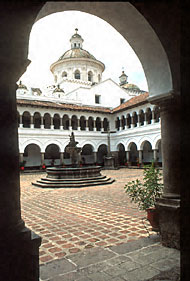
IGLESIA LA MERCED – Quito
La Merced Church in Quito

La iglesia de La Merced data del siglo XVI. Sin embargo, la estructura
original tuvo que ser modificada y reconstruida en el siglo XVIII, ya que los
terremotos habían causado graves daños en la edificación del templo.
En
La Merced, el arte se ve plasmado en los cuadros de tela al óleo del artista
Víctor Mideros, quien resalta en ellos temas de carácter religioso. Un reloj
inglés de luna negra, hecho en 1817 e instalado en 1820, se encuentra ubicado en
la torre de la iglesia. Una de las infraestructuras que no ha modificado su
fisonomía original es el claustro de La Merced, ya que conserva el
enladrillado.
Esta ubicada entre las calles Cuenca,Mejía, Imbabura y Chile. Se encuentra
abierta de lunes a viernes de 6:30 a 11:30 horas y de 15:00 a 18:30 horas, los
sábados de 9:00 a 11:00 horas y el domingo de 6:00 a 13:00 horas. [crédito de texto: Quito.gov.ec]
The Church of La Merced, dates back to the sixteenth century. Still, the original structure had to be modified and reconstructed in the eighteenth centruy, since earthquakes had caused grave damanges to the temple structure.
In La Merced, art is seen captured on the fabric squares -oil paintings by the artist Victor Mideros, who projects in them themes religious in character. An English clock with a black face, made in 1817 and installed in 1820, can be found in the church tower. On of the infrastructures that has not been modified from it’s original physiognomy ys the cloister of La Merced, as the brick flooring is preserved.
It is located between the streets Cuenca, Mejía, Imbabura and Chile. It is open Monday through Friday from 6:30am-1:30pm and 3:00pm-6:30pm, on Saturdays from 9-11am., and Sunday from 6:00 am to 1:00 pm. [loosely translated from text taken from Quito.gov.ec]
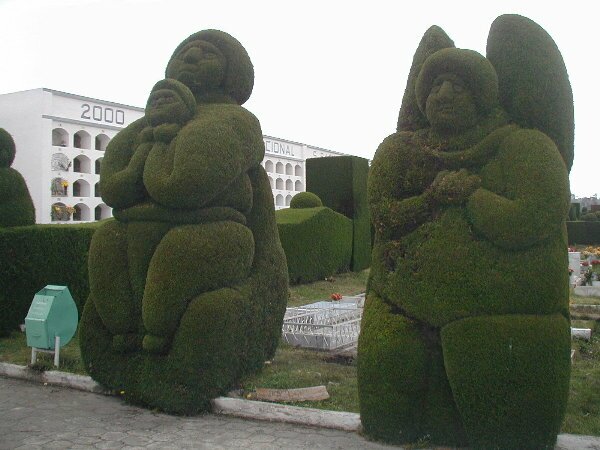
EL CEMENTERIO EN TULCÁN, PROVINCIA DE CARCHI
The Cemetery in Tulcán in the province of Carchi
 Puesto en la provincia de Carchi, Tulcán es una de las entradas al norte del país, hacia Colombia a solo 6km. Tiene un mercado atractivo en los domingos. La populación es solo 53,000 y el pueblo está a la elevación de 3000m de altura. Las calles estan generalmente largos y estrechos, metidos entre casas de los residentes locales.
La mayor atracción, desde 1936, para las turistas aquí, es el cementerio jardín ornamental con una variedad de formas creativas incluyendo ángeles, animales, y figuras geométricas. Está localizado dos bloques del Parque Ayora y vale la pena visitarlo. El creador, Sr. José Franco, quien está enterrado en el cementerio, dejó una oda intrigante de su cementerio artístico que dice, -En Tulcán, un cementerio tan bello que se invite a morir.- Hoy, los cinco hijos del Sr. Franco continuen en su tradición familiar de jardinería ornamental y están haciendo un grán trabajo esculturando estas formas esquisitas. (traducido de la página web de lo mejor del ecuador)
Set in the Province of Carchi, Tulcán is the entry point to the far
north of the country into Colombia just 6km away along with an attractive market
on Sundays. The population is just 53,000 and the town is set at an elevation of
3000m above sea level. The streets are generally very long and narrow and
crammed between the homes of local residents.
The biggest attraction dating back to 1936 for the tourists here is
the topiary garden cemetery featuring a wide variety of imaginative forms
and shapes including angels, animals and geometrical figures and is located 2
blocks from the Park, Parque Ayora and is well worth a visit. The deceased
creator Sr. José Franco who is actually laid to rest in the cemetery left an
intriguing written ode of his topiary cemetery which states “In Tulcán, a
cemetery so beautiful that it invites one to die”. Today the five sons of Sr.
Franco continue on with their topiary family tradition and are doing a grand job
in sculpturing these exquisite forms. (credit description directly from the best of ecuador web page)
SANGAY (17,150 ft.) as seen from EL ALTAR (17,450 ft.)

Baron Von Humboldt heard how, in a remote past, El Altar collapsed to a
size smaller than Chimborazo (the largest mountain in Ecuador). The outline of Altar’s slopes suggests that this
really did happen. Its name in Quichua “Capacurcu” means “majestic mountain.”
Río Nangaritza y cascada cerca de Nangaritza
Nangaritza River and Waterfall near Nangaritza