July 10, 2004

  • Sunset over the Pacific Ocean – Atacames, Ecuador


    © drc 1980


     El Tiempo en Quito Hoy: (The weather
    in Quito
    Today):


    (from elcomercio.com)

    AM: Nublado parcialmente
    PM:
    Lluvias aisladas


    Temperatura:
    Máx. 70°F / 21°C
    Min.  46°F /  8°C

    Humedad:
    Promedio. 77%

July 8, 2004

  • Sunset over the Pacific Ocean – Atacames, Ecuador


    © drc 1980


     El Tiempo en Quito Hoy: (The weather
    in Quito
    Today):


    (from elcomercio.com)

    AM: Nublado parcialmente
    PM:
    Lluvias aisladas


    Temperatura:
    Máx. 70°F / 21°C
    Min.  50°F / 10°C

    Humedad:
    Promedio. 54%

July 1, 2004

June 29, 2004

  • More about Camelids


    Llamas at Ingapirca, Inca Ruins in Southern Ecuador

    Information kyped from this web page

    Llamas are members of the Camel family. Technically, they are camelids.

    In
    the Old World, there are two different camels, the one-humped dromedary
    of the Arabian deserts, and the two humped Bacterian camel of the
    Mongolian deserts.

    In the New World, there are four different camelids. Three are in the genus Lama, the llama, the alpaca, and the guanaco. One is in its own genus vigunae, the vicuna.

    Both
    the guanaco and the vicuna are wild animals, and both have been or are
    endangered. Both have extremely fine fiber, the vicuna having the
    finest fiber in the world. The guanaco is somewhat llama sized, while
    the vicuna is a tiny, antelope like creature.

    The llama and the
    alpaca are both domesticated animals, and have never been wild.** [ed. I don't know about that... I believe there are plenty of wild llama and alpaca in the Andes!!] The
    llama is considerably larger than the alpaca. In South American, llamas
    are used for pack animals, production of fiber for rugs and ropes,
    meat, and even used their dung for fuel. In South America, the alpaca
    is used for fine fiber production, meat, and their dung for fuel.

    In
    the United States, llamas are used for light draft, fiber production,
    show, companion and guard animals. Alpacas are used for fine fiber
    production and show in the United States.

    The camelids are not
    ruminants, but they do ruminate. (I hope you don’t find that as
    confusing as I do.) They have some differences from true ruminants, in
    that they have a three compartmented stomach instead of the 4
    compartmented stomach of true ruminants, they have slower stomach
    motility, and their stomach movements are in the opposite direction to
    that heard for true ruminants. However, in terms of feeding, this boils
    down to the fact that they should be fed and treated as ruminants
    rather than as non-ruminants (such as horses). For example, oats should
    not be fed to llamas or alpacas, as the “awns” on oats can cause them
    to be caught up in one of the stomachs that has saccules, and then
    cause ulcers.

    The camelids are better at feed conversion than
    true ruminants as well. This means that it takes less feed to make more
    llama than it would a sheep. Camelids can survive on what would be
    considered something close to a desert for a sheep.

    Camels and
    camelids have two toed feet, with a toe nail sticking out of the end of
    each toe. However, they walk on a kind of leathery pad, which gives
    them excellent traction. In addition, this characteristic means that
    llamas can “cruise” delicate woodlands with little or no damage to the
    environment.

    All of the camel family has a bad reputation for
    spitting. What more experience has shown is that this type of behavior
    was developed for their interactions with each other, not as a way to
    gross out people. In fact, when camels and camelids are appropriately
    raised, they never spit in anger at people. (The big problem is making
    sure that you’re not in the wrong place when a “food fight” breaks out
    between llamas….)


    El Tiempo en Quito Hoy: (The weather
    in Quito
    Today):


    (from elcomercio.com)

    AM: Nublado parcialmente
    PM:
    Lluvias aisladas


    Temperatura:
    Máx. 72°F / 22°C
    Min.  50°F / 10°C

    Humedad:
    Promedio. 70%

June 28, 2004

June 22, 2004

  • Orquideas silvestres… se puede encontrar en la selva
    Wild Orchids… you can find these in the jungle


    El Tiempo en Quito Hoy: (The weather
    in Quito
    Today):


    (from elcomercio.com)

    AM: Soleado (sunny)
    PM:
    Soleado (sunny)


    Temperatura:
    Máx. 73°F / 23°C
    Min.  52°F / 11°C

    Humedad:
    Promedio. 58%


June 16, 2004

  • El Escudo Nacional del Ecuador

    The National Crest of Ecuador


    desde Vistazo

    El
    Escudo Nacional del Ecuador, ha pasado por una
    largo proceso de cambios dictados por los diferentes
    hechos históricos que ha vivido nuestro
    país. Pero fue en la presidencia del
    Gral. Eloy Alfaro, el Congreso Nacional de 1900
    aprobó por decreto los Símbolos
    Nacionales. En el artículo de su resolución
    del 31 de octubre de 1900, transcribe la disposición
    de 1845, con la única modificación
    de que se use los tres colores: amarillo, azul,
    rojo. Es decir se mantuvo el mismo escudo que
    dibujara José Joaquín de Olmedo
    (celeste y blanco) pero con el cambio de los
    colores de la bandera actual.

    The
    National Crest of Ecuador has passed through a large process of changes
    dictated by different historic actions that our country has lived
    through.  But it was during the presidency of General Eloy Alfaro,
    the National Congress of 1900 approved by decree the National
    Symbols.  In the article of its resolution of October 31 of 1900,
    it transcribes the disposition of 1845, with the only modification
    being the use of three colors, yellow, blue, red.  That is to say
    it maintained the same crest that José Joaquín de Olmedo had drawn
    (celeste and white) but with the change of the colors being those of
    the actual flag.


    El Escudo del Ecuador tiene varios elementos
    que los caracterizan y que simbolizan ciertos
    aspectos de nuestra nación: El cóndor
    con sus alas desplegadas que lo corona, simboliza
    el poderío, el valor y la pujanza del
    pueblo ecuatoriano. El sol, indica la posición
    del país en la mitad del mundo y recuerda
    que los Shyris y los Incas lo adoraban como
    dios. Los signos, que aparecen en la franja
    del zodiaco: Aries, Tauro, Géminis y
    Cáncer correspondientes a los meses de
    marzo, abril, mayo, junio, que fueron los meses
    que duró la lucha contra el despotismo
    del gobierno del Gral. Juan José Flores.
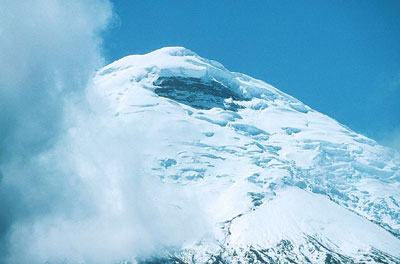
    El nevado simboliza el grandioso Chimborazo,
    ícono representativo del país,
    de sus laderas nace el río Guayas, representando
    a las regiones costa y sierra.

    The Crest of
    Ecuador has various elements that characterize and symbolize certain
    aspects of our nation:  The condor with his wings spread that
    crowns it, symbolizes the power, the valor and the vigor of the
    Ecuadorian people.  The sun, indicates the position of the country
    in the middle of the world and reminds that the Shyris and the Incas
    worshiped it as a god.  The signs which appear in the the
    zodiac:  Aries, Taurus, Gemini and
    Cancer correspond with the
    moths of March, April, May and June, that were the months that were
    endured fighting against the despotic government of General Juan José
    Flores.  The snowcap symbolizes the grandiose Chimborazo, icon
    representative of the nation, from whose side is borne the River
    Guayas, representing the regions of coast and sierra.


    El Barco a vapor en el que se aprecia una vara
    rodeada de culebras entrecruzadas, representa
    el primer barco construido en los Astilleros
    de Guayaquil dando inicio así al comercio.
    Los haces consulares sobre los que descansa,
    simbolizan la dignidad nacional y la forma republicana
    del gobierno. La ramita de laurel es la victoria,
    y la de palma es paz. Las cuatro banderas que
    lo rodean son el deber sagrado de cada ecuatoriano
    de velar por la integridad nacional y la grandeza
    del Ecuador.


    The
    steam ship that has a rod surrounded by crossing snakes, represents the
    first ship constructed in the shipyards of Guayaquil thereby giving
    rise to commerce.  The hatchets represent the consulate over which
    they rest, symbolizing national dignity and the republican form of
    government.  The laurel wreath is for victory, and the palm is
    peace.  The four flags that surround the crest are the sacred duty
    of every Ecuadorian to keep watch over the national integrity and the
    grandness of Ecuador.


    The actual decree:

     ”El Consejo Nacional del 31 de Octubre de 1900
    determinó en forma definitiva nuestra bandera patria, según decreto
    dice: El Pabellón Nacional será sin alteración alguna el que adoptó el
    Ecuador desde su independencia y sus colores son: amarillo, azul y rojo
    en franjas horizontales siendo el primero doble a los otros colores.

    El mismo decreto añade; “Las
    Armas del Ecuador serán un escudo ovalado que contengan interiormente
    en su parte superior el sol con los signos del zodiaco correspondiente
    a los meses memoriables de Marzo, Abril, Mayo y Junio; en la parte
    inferior se destacará el Chimborazo desde donde nacerá un río hasta
    aparecer más caudaloso, en el que estará un buque de vapor que tenga
    por mastil un caducero, como símbolo de la Navegación Nacional y el
    Comercio. El Escudo reposará en un Lid de Haces Consulares, como
    insignia de la dignidad Republicana, será adornado exteriormente con
    banderas Nacionales y coronado por un Cóndor con las alas desplegadas”.


    English Translation


    The National Council of October 31, 1900, determined definitively that
    our national flag, according to decree, states: The National Emblem
    will remain unaltered in any from that which has been adopted by
    Ecuador since its independence, and its colors are: yellow, blue and
    red, in horizontal stripes, with the first twice the width of the
    others.


    The same decree adds: “Ecuador’s Coat of Arms will be an oval shield which contains within

    it in the upper section the sun with the signs of
    the zodiac corresponding to the memorable months of March, April, May
    and June; on the lower portion Mt. Chimborazo will dominate, from which
    a river will emerge and broaden, upon which will be a steamship which
    will display as its mast a caduceus, as a symbol of national commerce
    and navigation. The shield will rest on a bundle of hatchets,
    pertaining to the council, as the insignia of the dignity of the
    Republic, adorned in a framework of national flags and crowned by a
    condor with fully extended wings.


June 14, 2004

  • Nubes en los páramos de Saraguro…

    Clouds gathering on the páramos of Saraguro…


    photo credit via link


    photo credit via link

    Cloud forest in the Cordillera de Saraguro above Yacuambi


    El Tiempo en Quito Hoy: (The weather
    in Quito
    Today):


    (from elcomercio.com)

    AM:
    Nublado parcialmente (partly
    cloudy)

    PM:
    Lluvias aisladas (isolated showers)


    Temperatura:
    Máx. 72°F / 22°C
    Min.  52°F / 11°C

    Humedad:
    Promedio. 50%

June 13, 2004

  • El Trén desde Quito hasta Guayaquil…
    The Train from Quito to Guayaquil


    photo credit via link
    en route passing Alausí


    El Tiempo en Quito Hoy: (The weather
    in Quito
    Today):


    (from elcomercio.com)

    AM:
    Nublado parcialmente (partly
    cloudy)

    PM:
    Lluvias aisladas (isolated showers)


    Temperatura:
    Máx. 72°F / 22°C
    Min.  46°F / 8°C

    Humedad:
    Promedio. 50%

June 10, 2004

  • ¿Verás la Copa Mundial en 2006?

    Will you be watching the World Cup in 2006?

    You can get some Ecuador soccer paraphernalia here
    Obtenga información acerca de los equipos ecuatorianos de futból aquí
    More information on FIFA’s site (you pick the language)
    Más informacion en el sitio de FIFA (ud. escoga el idioma)


    You can buy the above shirt  here
    (of course I will! I already have the 2002 gift set )


    El Tiempo en Quito Hoy: (The weather
    in Quito
    Today):


    (from elcomercio.com)

    AM:
    Nublado parcialmente (partly
    cloudy)

    PM:
    Lluvias aisladas (isolated showers)


    Temperatura:
    Máx. 70°F / 21°C
    Min.  48°F / 9°C

    Humedad:
    Promedio. 58%